2026 Job Automation Risks: How Robots Affect Employment

Co-Founder and Chief Data Scientist
Automation is already changing how people get hired, trained, supervised, and promoted. The real issue is not whether machines will “take over” all work. It is which tasks are easiest to automate, which occupations are most exposed, and what workers, students, schools, and employers should do next.
This matters now because AI tools, robotics, scheduling systems, self-service platforms, and automated decision software are being used across industries. At the same time, labor-market change is being shaped by pay, advancement, workplace culture, and worker expectations—not by technology alone. In the U.S., the labor market still recorded a hiring rate of 3.3%, equal to 5.3 million new hires, alongside a quit rate of 2%, or 3.1 million workers (BLS, 2026). That context makes the automation conversation more practical: the question is how to adapt, not whether to panic.
In this guide, you’ll learn what the Oxford automation study actually found, how later research changed the debate, which jobs face higher and lower exposure, where automation still struggles, and how to choose education or reskilling options that make career sense in 2026. The goal is simple: help you make better decisions about school, work, and long-term career resilience.
Quick Answer: Will Automation Replace Your Job?
Usually, automation replaces tasks before it replaces entire jobs. Roles built around repetitive, predictable, rules-based work are most exposed. Jobs that rely on judgment, empathy, creativity, leadership, caregiving, physical adaptability, or complex problem-solving are harder to automate.
The Oxford study estimated that 47% of jobs were susceptible to computerization, but later research offered lower estimates: 9% in the ZEW Mannheim analysis and 14% in the OECD analysis, with an additional 32% of jobs likely to change significantly rather than disappear. The most useful takeaway is not to ask whether a job title is “safe.” Instead, examine the tasks inside the job and identify which ones technology can already do well.
What this article covers
- Jobs most exposed to automation in 2026
- Jobs with lower automation exposure in 2026
- How later studies changed the automation debate
- Where automation still falls short
- How automation can also create work
- Why affordable higher education matters in an automated economy
- How employers can prepare workers for automation
- How education systems can prepare future workers
- Long-term economic and social effects of automation on job quality
- How organizations can build continuous reskilling cultures
- Whether accelerated master’s programs support fast upskilling
- Whether 1-year master’s programs can close automation skill gaps
- How alternative education pathways can speed workforce adaptation
- How to evaluate education ROI in an automated economy
- How workers can fund reskilling and upskilling
- Economic benefits of high-value specialized education
- Whether a specialized doctoral degree can strengthen career resilience
- Whether an accelerated associate degree can support future-ready careers
- How affordable associate degrees support workforce adaptability
- Ethical issues in automation and workforce equity
- Whether industry certifications can close automation skill gaps
- Examples of successful workforce transitions
- Policy measures that can support a balanced automation transition
- How workers can adapt to automation-driven change
- How specialized degrees prepare workers for automated job markets
- The strategic value of specialized degrees in the automation era
What the Oxford Automation Study Found
The Oxford study asked a direct question: if computerization, machine learning, robotics, or related technologies can perform the core tasks in a job, how vulnerable is that occupation? The researchers reviewed 702 jobs and grouped them into high, medium, and low risk of computerization. Their headline estimate—that 47% of jobs could be replaced by machines—became one of the most cited numbers in the automation debate.
That figure should not be read as a forecast that 47% of workers would immediately lose jobs. It was a measure of exposure, not a prediction of mass unemployment. In practical terms, the most vulnerable jobs tend to involve routine, repeatable work with limited need for creativity, judgment, social interaction, or adaptation.
Jobs Most Exposed to Automation in 2026
In the Oxford framework, the highest-risk occupations are concentrated in transportation and logistics, administrative and office support, and production work. The study also identified elevated exposure in service, sales, and construction roles. Farming, fishing, forestry, installation, maintenance, and repair can also be vulnerable when the tasks are routine enough to be standardized.
Some STEM career paths are affected too, especially when work involves repeated testing, monitoring, calculations, or procedures that software can do safely and consistently. Even so, STEM fields often create new work in design, oversight, quality control, compliance, and system improvement.
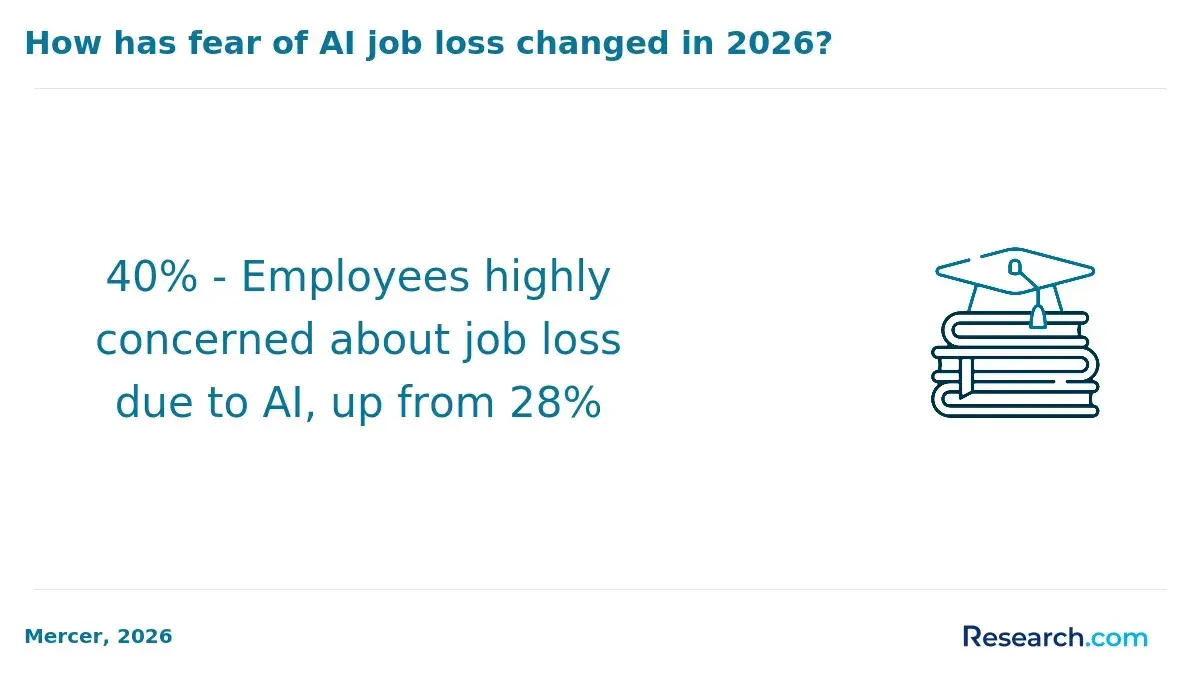
Concern about AI is rising among workers and business leaders. A 2026 Mercer survey found that 40% of employees are highly concerned about losing jobs to AI, up from 28% the previous year. The same survey said 99% of business leaders expect AI-driven headcount cuts within 2 years. That does not mean every worker is at risk, but it does show that staffing decisions are being reshaped by automation expectations.
According to the Oxford study, these ten occupations were among the most exposed to computerization:
- Telemarketers
- Title Examiners, Abstractors, and Searchers
- Sewers, Hand
- Mathematical Technicians
- Insurance Underwriters
- Watch repairers
- Cargo and freight agents
- Tax preparers
- Photographic process workers and processing machine operators
- New accounts clerks
What Makes a Job Easier to Automate?
| Job feature | Why it raises automation exposure | Better response |
| Repetitive tasks | Machines are strong at repeating the same action consistently under fixed rules. | Move toward analysis, troubleshooting, customer judgment, or supervision. |
| Structured data handling | Software can quickly sort, compare, retrieve, and process standardized information. | Build skills in interpretation, compliance review, quality control, or system oversight. |
| Low human interaction | Roles with limited interpersonal work are easier to redesign around automation. | Strengthen advising, negotiation, communication, training, or client-facing skills. |
| Predictable physical setting | Robotics works best when objects, spaces, and conditions stay consistent. | Develop equipment support, safety oversight, maintenance, or process-improvement skills. |
Jobs With Lower Automation Exposure in 2026
Jobs with lower exposure usually involve unpredictable situations, human care, complex manual skill, emotional understanding, or high-stakes judgment. These occupations depend on social intelligence, ethical reasoning, adaptability, and flexible problem-solving—capabilities machines still struggle to match.
That is why many social science careers, healthcare roles, therapy-related occupations, and supervisory positions tend to appear lower on automation-risk lists. They may use AI tools, but their value still comes from human judgment and relationships.
The Oxford study identified these ten occupations as among the least likely to be automated:
- Recreational therapists
- First-line supervisors of mechanics, installers, and repairers
- Emergency management directors
- Mental health and substance abuse social workers
- Audiologists
- Occupational therapists
- Orthotists and prosthetists
- Healthcare social workers
- Oral and maxillofacial surgeons
- First-line supervisors of fire fighting and prevention workers
The full Oxford list of 702 occupations is available in the original report.
For students interested in helping professions that remain difficult to automate, mental health and substance abuse social work is one example where empathy, case-specific decision-making, and human trust remain central. Learners comparing graduate routes can review affordable online MSW programs as one possible entry path.
How Later Studies Changed the Automation Debate
Later studies questioned whether nearly half of all jobs would really disappear. The difference comes from methodology. The Oxford study focused on occupations as the main unit of analysis. Later research examined tasks inside jobs and found that two workers with the same title may have very different exposure levels.
The ZEW Mannheim study estimated that only 9% of jobs were likely to be lost to automation after accounting for task variation within occupations (Arntz et al., 2017). Its key point was that automation risk differs across workers, even when the job title is the same. The model also considered demographic and socioeconomic factors such as gender, age, education, and income.
The Oxford authors criticized that approach, arguing that a machine can do a task regardless of the worker’s age, gender, or income. From that perspective, the task itself should drive the estimate—not the profile of the person doing it.
The OECD took a middle position. Its study estimated a direct automation risk of 14%, while another 32% of jobs were likely to change substantially because of automation (Nedelkoska & Quintini, 2018). That distinction matters: a role can be transformed without disappearing.
| Study or source | Main estimate | How to read it |
| Oxford study | 47% of jobs susceptible to computerization | Shows broad occupation-level exposure, especially in routine work. |
| ZEW Mannheim study | 9% of jobs likely to be lost to automation | Emphasizes task differences inside occupations and gives a lower displacement estimate. |
| OECD study | 14% of jobs at risk, with another 32% likely to change significantly | Suggests automation may reshape more jobs than it eliminates. |
Even with different estimates, the message is consistent: automation risk depends on the tasks being done. Repetitive, rules-based work is easier to automate. Work involving care, creativity, interpretation, communication, and social context is more resilient. A sociology degree, for example, develops analysis of behavior, institutions, and social systems—areas where context matters and machines have clear limits.
Employee Sentiments About Their Skills

Why the Conversation Keeps Evolving
More recent research treats automation as both a disruption and a source of new work. Automation can replace some tasks, but it can also create demand for new services, new occupations, and new ways of organizing work. Acemoglu and Restrepo (2019) describe a “reinstatement effect,” in which technology creates new tasks that bring labor back into parts of the economy that previously had little or no work.
In Asia, technological progress has supported productivity, employment growth, and digital entrepreneurship. At the same time, automation can widen inequality if women, rural communities, and people with disabilities have less access to training and opportunity (ERIA, 2022). The core policy issue is not whether automation should happen. It is whether workers can access the learning paths needed to benefit from it.
The World Economic Forum argues that public institutions and private employers both need to update labor systems for a digital economy. ERIA makes a similar point: reskilling and upskilling must be expanded so skill shortages do not block access to emerging jobs.
The WEF’s 2025 Future of Jobs Report estimates that AI and processing technology will displace around 9 million jobs while creating around 11 million. That is a net positive in the report’s model, but only if workers can move into the new roles.
Skills shortages remain a major constraint. Digital adoption accelerated during the pandemic, and the Great Resignation made workforce gaps harder to ignore. Digitalization is now supporting electric vehicles, energy transition efforts, sustainable-economy projects, platforms, and new business models. Yet TalentLMS found in 2026 that 42% of companies report workforce skills gaps.
For students wondering, what can I do with a psychology degree, this is a useful lens. Psychology-based training can lead to roles involving behavior, assessment, communication, research, counseling support, organizational development, and user experience—fields where understanding people remains valuable.
Workers Usually Quit for Reasons Other Than Automation
Labor turnover data also complicate the automation story. A Randstad study (2026) found that pay is the top factor workers consider when looking for a job. It also found that 74% want security in their jobs, and 47% would leave if they felt they did not belong in the workplace.
That suggests workers are not simply running from machines. They are responding to compensation, security, culture, belonging, respect, and advancement. Automation may influence those conditions, but it does not explain them by itself.
Workers' Top Factors When Looking for Employment
Where Automation Still Falls Short
Automation works best in predictable settings. It struggles when situations are ambiguous, emotionally sensitive, physically irregular, or ethically complex. The Oxford study highlighted three broad areas where human workers still have an edge.
Social intelligence
Machines can analyze language, sentiment, voice, and facial patterns, but they do not truly understand empathy, trust, persuasion, caregiving, or negotiation. A system may detect frustration in a customer’s message, but it cannot grasp the full personal and cultural context behind that frustration.
This is why healthcare, counseling, education, management, sales, mediation, social work, emergency response, and leadership remain human-centered. Technology can support those jobs, but it does not replace the human relationship at the core of the work.
Creative intelligence
Generative AI has changed creative work, but it has not removed the need for people to define problems, shape strategy, judge originality, understand audiences, and make choices about what is ethical or useful. Creativity does not work like a simple formula because it depends on experience, taste, context, emotion, and experimentation.
Scientific discussion of creativity is still developing. A Scientific American analysis discussed research on the interaction between brain hemispheres and the corpus callosum (Kaufman, 2013). Other research points to the influence of environment, play, exposure, family behavior, and learning conditions on creative development.
In fields such as marketing, design, writing, product development, strategy, entertainment, and entrepreneurship, automation is more likely to alter workflows than eliminate the need for creative direction. Tools can produce options, but people still decide what matters.
Dexterity and human senses
Robotics has advanced quickly in controlled environments, but many physical jobs involve irregular objects, changing conditions, and real-time adaptation. A robot may work well on a structured production line or in a highly organized warehouse. It is less reliable when shape, texture, fragility, or placement changes.
That is why surgeons, dentists, mechanics, carpenters, jewelers, technicians, and other skilled manual workers still rely on perception, hand control, situational awareness, and judgment. Automation may support these workers, but replacing the full range of human adaptability remains difficult.
How Automation Can Also Create Work
The automation debate often focuses on losses. A more complete view also considers the jobs that evolve or emerge. Automation can increase productivity, reduce dangerous work, expand access to services, and create demand for people who design, maintain, interpret, govern, and improve technology.
That is why students should think about automation exposure when choosing a university course. The goal is not to avoid technology. It is to choose a path that builds durable skills: analytical thinking, communication, digital fluency, ethical reasoning, problem-solving, and adaptability.
A McKinsey study (2017) predicted that healthcare, IT, management, education, construction, and creative fields could see job growth tied to automation and related economic shifts. The drivers included rising consumption and income, aging populations, technology deployment, infrastructure investment, renewable energy investment, and domestic work.
Students drawn to human behavior, care, and communication may consider graduate pathways such as psychology masters programs Florida offers. The broader point is that automation changes the labor market, but it does not eliminate human-centered work.
Why Affordable Higher Education Matters in an Automated Economy
Affordable higher education matters because automation rewards people who can keep learning without taking on unsustainable debt. Workers most exposed to automation often cannot stop working for a long, expensive retraining period. Flexible and lower-cost programs make reskilling more realistic.
For many adults, the best program is not the longest or most prestigious one. It is the one that fits the target role, matches the schedule, holds the right accreditation, accepts transfer credits when possible, and leads to skills employers actually use. Students comparing options may begin with affordable online bachelor’s degree options if they need a flexible route to a credential.
The strongest programs combine technical ability with human skills. Workers who can survive automation usually bring data literacy, digital tools, communication, creativity, ethics, teamwork, and problem-solving. A narrowly technical credential may not be enough if it does not also build judgment and adaptability.
Education pathways that can support automation readiness
| Pathway | Best fit | Main caution |
| Associate degree | Students who want a shorter route into technical, healthcare, business, or applied fields. | Check transfer options if a bachelor’s degree may be needed later. |
| Bachelor’s degree | Learners who need a broad credential for career mobility or entry into professional roles. | Compare total cost, completion time, and employer relevance—not tuition alone. |
| Master’s degree | Professionals aiming for specialization, leadership, analytics, AI, healthcare, education, or management roles. | Make sure the degree directly supports a target career outcome. |
| Certificate or certification | Workers who need a focused skill upgrade in less time than a degree usually takes. | Verify that employers in the field actually value the credential. |
How Employers Can Prepare Workers for Automation
Employers cannot manage automation responsibly by purchasing software and cutting roles without a transition plan. A stronger approach is to redesign work, train employees, and use technology where it raises productivity without wasting human skill.
- Review tasks before eliminating positions. Identify which tasks are repetitive, risky, slow, or error-prone, then decide whether automation should assist, replace, or improve them.
- Invest in upskilling and reskilling. Training in digital tools, AI literacy, data analytics, cybersecurity basics, and process improvement can help workers move into higher-value work.
- Redesign jobs around human strengths. Employees can shift from repetitive processing to customer support, quality review, exception handling, team leadership, and judgment-heavy work.
- Use collaborative automation. Cobots and AI assistants can support workers instead of fully replacing them when both machine consistency and human flexibility are useful.
- Build a learning culture. Workers adapt faster when training is ongoing, practical, manager-supported, and connected to advancement.
How Education Systems Can Prepare Future Workers
Schools, colleges, and training providers need to prepare learners for work that is more digital, more interdisciplinary, and less predictable. That means teaching technology skills while also strengthening the human capabilities that remain valuable when tools change.
- Strengthen STEM foundations. Science, technology, engineering, and mathematics help students understand automation, AI, robotics, data, and systems thinking.
- Teach digital-age skills broadly. Coding, data analysis, cybersecurity awareness, AI literacy, and digital communication should appear in more programs, not only computer science.
- Teach soft skills on purpose. Communication, teamwork, leadership, critical thinking, creativity, and ethical reasoning should be practiced and assessed.
- Support lifelong learning. Working adults need flexible options, including programs through accredited online colleges, so they can study without leaving work.
- Partner with employers. Internships, apprenticeships, advisory boards, and updated modules help align curricula with actual job tasks.
What Are the Long-Term Economic and Social Effects of Automation on Job Quality?
Automation can improve job quality when it removes dangerous, dull, or physically exhausting tasks and leaves workers with more analytical, interpersonal, or creative work. It can also reduce job quality if employers use it for excessive monitoring, weaker bargaining power, or unstable scheduling.
The outcome often depends on access to training. Workers who can build advanced technical and human-centered skills may gain mobility, while those without training access may face stagnation or displacement. Specialized education, including an online master’s in AI, can help some professionals move into jobs that design, govern, evaluate, or apply automation rather than compete directly with it.
How Can Organizations Build a Culture of Continuous Reskilling?
Continuous reskilling works best when it is part of regular operations, not a one-time response to disruption. Employers should assess skills regularly, map future role needs, and create clear learning pathways tied to internal mobility.
Partnerships with education providers can make training easier to scale. For workers balancing jobs and family responsibilities, online degrees for working adults may be more practical than traditional full-time study. Employers can increase participation with tuition help, paid learning time, mentoring, and transparent promotion standards.
Are Accelerated Master’s Programs an Effective Way to Upskill Quickly?
Accelerated master’s programs can work well when a professional already has a foundation in the field and needs focused, advanced training fast. They are less suitable when the student lacks prerequisite knowledge or needs extensive hands-on experience before changing roles.
Programs marketed as 6 month masters degree programs may appeal to workers facing urgent skill gaps, but speed should not be the only filter. Students should review accreditation, curriculum depth, faculty expertise, employer recognition, workload, and whether the program’s outcomes match their target role.
Can 1-Year Master’s Programs Close Skill Gaps in an Automated Economy?
Well-designed 1 year masters programs can help professionals move into higher-skill roles if the program is focused, rigorous, and aligned with labor-market needs. Strong options combine technical coursework, applied projects, industry input, and career support.
But shorter is not always better. A compressed program can be demanding, and students should be realistic about weekly study time, prior preparation, and whether they can use the new skills while working. The better question is not “How fast can I finish?” but “Will this credential help me do the next job well?”
Can Alternative Education Pathways Speed Workforce Adaptation?
Degrees are only one route to automation readiness. Boot camps, certificates, micro-credentials, apprenticeships, employer training, and short courses can help workers gain targeted skills quickly. These options are especially helpful when the skill is narrow, such as cloud tools, data visualization, medical coding software, cybersecurity basics, or digital marketing platforms.
Career changers may also benefit from structured routes that combine training with placement support. Resources on degree programs for career changers can help workers compare formal and alternative pathways. The right option depends on current education, target field, budget, time, and whether a recognized credential is required.
Is the ROI of Specialized Education Worth It in an Automated Economy?
Specialized education is worth the cost when it leads to a realistic career move, strengthens automation-resistant skills, and does not create debt that cancels out the benefit. ROI should be evaluated before enrollment, not after graduation.
Students should compare tuition, fees, lost work time, length, transfer-credit policy, employer demand, graduation support, and likely career outcomes. Shorter options such as fast online degrees can be attractive, but speed and affordability still need to be balanced against quality, accreditation, and relevance.
Questions to ask before paying for reskilling
- What job or promotion is this program supposed to help me reach?
- Do employers in that field require, prefer, or ignore this credential?
- Is the institution properly accredited for my goals?
- Will credits transfer if I continue to a higher degree?
- What software, labs, projects, or clinical experiences are included?
- Can I handle the workload while working?
- What is the total cost after fees, books, technology, and lost income?
How Can Workers Pay for Reskilling and Upskilling?
Cost is one of the biggest barriers to retraining. Workers should look into employer tuition assistance, scholarships, workforce-development programs, payment plans, federal loan options, and lower-cost institutions before assuming advanced training is out of reach.
Professionals considering graduate study may compare affordable online master’s programs to reduce financial pressure. But the cheapest option is not always the best value. Price should be weighed against accreditation, completion support, career relevance, and flexibility.
What Are the Economic Benefits of High-Value Specialized Education?
Specialized education can improve employability when it teaches skills that are hard to automate and useful across industries. These often include AI governance, software engineering, data analysis, healthcare leadership, cybersecurity, project management, education technology, and advanced clinical or technical practice.
Workers comparing graduate options may look at master’s degrees that pay well, but salary should not be the only factor. A good fit also depends on aptitude, local or remote job openings, licensing requirements, program quality, and long-term interest in the work.
Can a Specialized Doctoral Degree Future-Proof Your Career?
A doctoral degree can strengthen career resilience in fields that require deep expertise, original research, leadership, policy work, or advanced clinical judgment. Automation can assist with research and analysis, but it does not replace the human responsibility for framing questions, interpreting evidence, setting priorities, and leading complex organizations.
Doctoral study is a major commitment, so the purpose should be clear. Students comparing cost-conscious options can examine the most affordable online doctorate programs while also checking accreditation, dissertation or capstone requirements, faculty fit, and career outcomes.
Is an Accelerated Associate Degree a Good Foundation for an Automated Future?
An accelerated associate degree can be a practical starting point for students who need to enter the workforce quickly or build credits toward a bachelor’s degree. It can support roles in healthcare, IT support, business administration, criminal justice, applied technology, and other fields where foundational training matters.
Students looking into the fastest way to get an associate's degree online should make sure the pace is realistic. Fast formats save time, but they often require strong time management and steady weekly study.
Can Affordable Associate Degrees Improve Workforce Flexibility?
Affordable associate degrees can support workforce adaptability by giving students a lower-cost entry into postsecondary education. They can also provide transfer credits, technical preparation, and a credential that may help with entry-level hiring.
Some learners start by comparing which associate degree is easiest, but ease should not be the main goal. A better choice is a program that is manageable, accredited, relevant to a target job, and connected to future education or promotion opportunities.
What Are the Ethical Risks of Automation for Workforce Equity?
Automation can widen inequality if companies use opaque algorithms, if training access favors already-advantaged workers, or if displaced employees receive little support. Ethical automation requires fairness, accountability, bias monitoring, worker voice, and accessible reskilling.
Flexible credentials such as associate online degrees in 6 months may help some workers move faster, but policymakers and employers should ensure that rapid programs are not lower-quality substitutes reserved for vulnerable groups. Equity depends on both access and quality.
Can Industry Certifications Bridge the Automation Skills Gap?
Industry certifications can close specific skill gaps faster than degrees when employers value the credential and the certification maps to an actual job function. They are especially common in IT, cloud computing, cybersecurity, data tools, project management, and healthcare administration.
Workers comparing the highest paying certifications without degree should check prerequisites, renewal rules, exam costs, employer recognition, and whether the credential fits a longer career plan. Certifications work best when paired with real experience and a portfolio of skills.
Examples of Successful Workforce Transitions
Successful automation transitions usually involve governments, employers, schools, and workers working together. These examples show different ways communities have supported adaptation.
- Germany’s dual education system. This model combines classroom learning with workplace training. Employers and vocational schools share responsibility for preparing students with both academic knowledge and practical skills.
- Singapore’s SkillsFuture initiative. SkillsFuture gives citizens support for professional development through subsidies for courses and certifications, helping workers move into digital, data, and AI-related fields.
- U.S. tech-sector reskilling programs. Companies such as Google and Microsoft have created training initiatives focused on digital skills, cloud computing, and data analysis.
- The Netherlands’ continuing education approach. Dutch organizations and education providers emphasize ongoing skill updates in coding, robotics, and advanced manufacturing.
- Community programs in Northern England. Local training centers have partnered with regional employers to build reskilling programs for workers affected by automation in manufacturing and warehousing.
These examples show that workforce transitions work best when training is accessible, job-linked, and supported by more than one institution. Workers considering graduate-level preparation can compare the cheapest online masters options while still checking fit for their career goals.
What Policy Measures Can Support a Balanced Automation Transition?
Balanced automation policy should protect workers without blocking useful innovation. Governments can support that balance with retraining subsidies, portable benefits, career counseling, regional workforce programs, infrastructure spending, fair labor standards, and incentives for employers that retrain instead of simply replace.
Policy should also support practical routes into growing fields. For example, affordable healthcare administration and billing pathways, including the cheapest medical billing and coding program options, can help some workers move into roles where digital systems matter but human oversight and compliance knowledge still matter too.
How Can Workers Adapt to Automation-Driven Change?
Workers do not need to predict every detail of AI’s future to make better career decisions. They need to understand which tasks they do now, which skills transfer, and what learning options will make them more valuable in technology-enabled workplaces.
- Assess tasks, not just job titles. List the parts of your job that are repetitive, rules-based, data-heavy, interpersonal, creative, physical, or judgment-based. That shows where automation may affect you first.
- Build transferable human skills. Communication, leadership, empathy, negotiation, writing, critical thinking, and problem-solving remain useful across occupations.
- Add digital fluency. Learn the tools used in your field, whether that means AI assistants, analytics platforms, customer systems, cybersecurity practices, or industry software.
- Consider career diversification. Workers in vulnerable roles may benefit from credentials in healthcare management, digital marketing, IT, AI programming, project coordination, or analytics.
- Choose education strategically. A fast online bachelor’s degree may help some students advance quickly, but accreditation, quality, and career fit still matter.
- Use remote and hybrid work carefully. Digital work can expand access to jobs, but it also increases competition. Strong, demonstrable skills matter more than ever.
- Stay adaptable. Tools and workflows change. Workers who keep learning and can move into adjacent roles are better positioned than people who depend on one fixed job description.
Common Mistakes to Avoid When Preparing for Automation
| Mistake | Why it hurts | Better approach |
| Assuming your whole job is either safe or doomed | Automation usually changes tasks first, not entire occupations. | Study your daily work and identify the most exposed tasks. |
| Choosing a program only because it is fast | Fast credentials may lack depth or employer recognition. | Compare accreditation, curriculum, outcomes, and workload. |
| Focusing only on technical skills | Technical tools change quickly, while human skills often drive advancement. | Pair digital skills with communication, leadership, ethics, and problem-solving. |
| Ignoring accreditation | Unrecognized credentials can limit transfer, licensure, aid, or employer acceptance. | Verify accreditation before enrolling. |
| Waiting until displacement happens | Reskilling is harder under financial and emotional pressure. | Start with small, targeted learning steps while employed. |
How Do Specialized Degrees Prepare Workers for Automated Job Markets?
Specialized degrees can help workers move from automation-exposed tasks into roles that require deeper expertise, system-level thinking, and applied judgment. Fields such as software engineering, artificial intelligence, data science, healthcare, project management, cybersecurity, and analytics often need people who can use technology rather than be replaced by it.
For professionals who want to coordinate complex work across teams, budgets, timelines, and technologies, project management degree programs can provide a useful base. Project roles depend heavily on communication, risk management, stakeholder alignment, and decision-making—skills automation can assist but not fully replace.
The Strategic Value of Specialized Degrees in the Automation Era
A specialized degree is most valuable when it lines up with a real labor-market need and strengthens skills that complement automation. Software engineering is a strong example because automated tools still need people who understand architecture, security, testing, user needs, and system design. Students comparing options may review a master's in software engineering online as one pathway into advanced technical work.
Online programs can be especially useful for working adults because they let students keep earning while studying. But flexibility does not guarantee quality. Before enrolling, compare accreditation, faculty experience, course content, technical requirements, capstone opportunities, employer partnerships, and student support.
The best education strategy is not to chase every new technology trend. It is to build a durable mix of technical fluency, human judgment, adaptability, and field-specific expertise. Workers who can translate technology into useful decisions will have more options than those trained only for repetitive execution.
Key Insights
- Automation changes tasks before it eliminates careers. Job titles can be misleading; the real risk depends on how repetitive, predictable, interpersonal, creative, or judgment-heavy the work is.
- The Oxford study shaped the debate, but later studies were less severe. ZEW Mannheim estimated 9% of jobs at risk, while the OECD estimated 14% at risk and another 32% likely to change significantly.
- The highest-risk jobs are routine and rules-based. Telemarketers, title examiners, hand sewers, tax preparers, cargo and freight agents, and similar roles appeared among high-risk occupations in the Oxford analysis.
- The most resilient jobs rely on human capabilities. Therapy, healthcare, emergency management, supervision, social work, and skilled manual or clinical roles are harder to automate because they depend on empathy, context, judgment, and dexterity.
- Workers are not quitting mainly because of automation. Evidence from the Great Resignation points to pay, advancement, respect, security, belonging, and workplace culture as major reasons people leave.
- Automation can create jobs as well as displace them. The WEF’s 2025 Future of Jobs Report estimates around 9 million jobs displaced by AI and processing technology and around 11 million created.
- Skills gaps are the central challenge. TalentLMS reported that 42% of companies face workforce skills gaps, making reskilling and upskilling essential for workers and employers alike.
- Education decisions should be practical and ROI-focused. Students should compare accreditation, cost, time, transferability, employer recognition, and fit with target roles before enrolling.
- The best career defense is adaptability. Combining digital fluency with communication, creativity, ethics, leadership, and problem-solving is stronger than relying on any single credential or title.
References:
- Acemoglu, D., & Restrepo, P. (2019). Automation and new tasks: How technology displaces and reinstates labor. Journal of Economic Perspectives, 33(2), 330. https://doi.org/10.1257/jep.33.2.3
- Advaithi, R. (2022, September 26). How automation and job creation can move together. World Economic Forum.
- Arntz, M., Gregory, T., & Zierahn, U. (2017). Revisiting the risk of automation. Economics Letters, 159, 157-160. https://doi.org/10.1016/j.econlet.2017.07.001
- Frey, C., & Osborne, M. (2013, September). The future of employment: How susceptible are jobs to computerisation? Technological Forecasting and Social Change, 114, 1-72. https://doi.org/10.1016/j.techfore.2016.08.019
- Future of Work in Asia Conference focuses on technological advancement and forward-looking entrepreneurship. (2022). Economic Research Institute for ASEAN and East Asia ERIA.
- Kaufman, S. (2013, August 19). The real neuroscience of creativity. Scientific American.
- Hoicka, E. (2017, January 12). Five ways to make your child a creative genius. The Conversation.
- Manyika, J., Lund, S., Chui, M., Bughin, J., Woetzel, J., Batra, P., Ko, R., & Sanghvi, S. (2017, November). Jobs lost, jobs gained: What the future of work will mean for jobs, skills, and wages. McKinsey Global Institute.
- Mercer. (2026). Global Talent Trends 2026: Driving exponential performance. Mercer.
- Nedelkoska, L., & Quintini, G. (2018). Automation, skills use and training. OECD Social, Employment and Migration Working Papers, No. 202. https://doi.org/10.1787/2e2f4eea-en
- Parker, K., & Juliana Menasce Horowitz. (2022, March 9). Majority of workers who quit a job in 2021 cite low pay, no opportunities for advancement, feeling disrespected. Pew Research Center.
- Randstad. (2025). The Gen Z Workplace Blueprint: Future focused, fast moving. Randstad.
- Randstad. (2026). Workmonitor 2026: The Great Workforce Adaptation. Randstad.
- TalentLMS. (2026). 2026 Annual L&D Benchmark Report. TalentLMS.
- U.S. Bureau of Labor Statistics. (2026, March 13). Job Openings and Labor Turnover Summary, January 2026. BLS.
Other Things You Should Know About Job Automation Risks
Recent studies indicate that 2026 job automation risks are increasing for repetitive tasks, particularly in manufacturing and clerical work. However, roles requiring emotional intelligence, problem-solving, and creativity face lower risk. Continuous adaptation and upskilling are vital for workforce resilience.
Jobs that are routine and do not require much creativity or interpersonal interaction are most at risk of automation. These include telemarketers, tax preparers, hand sewers, and title examiners.
Jobs that require creativity, social intelligence, and dexterity are least likely to be automated. Examples include recreational therapists, emergency management directors, healthcare social workers, and occupational therapists.
In 2026, governments and organizations play a critical role in managing automation's impact by implementing policies that promote workforce retraining, encouraging investment in skill development programs, and ensuring a balanced transition. Collaboration between industry and educational institutions is essential for preparing workers for the evolving job market.
Yes, automation can lead to job growth in sectors like healthcare, IT, education, and construction due to rising consumption, technological advancements, and infrastructure investments. It can create new job roles that require human skills.
The workforce should focus on reskilling and upskilling to adapt to new job roles created by automation. Emphasizing skills in creativity, social intelligence, and technology will be crucial in the evolving job market.
Governments and organizations should work together to reform the labor system, ensuring equal access to reskilling and upskilling opportunities. Policies should support a smooth transition to a digital, knowledge-based economy.
While automation will undoubtedly change the job landscape, the fear of massive job loss may be overstated. Automation is likely to create new job opportunities and shift existing roles, emphasizing the need for continuous learning and adaptation.